

Dating is dead
+ honestly, this could be the best thing that's ever happened.

Hello, my loves!
I’ve been reflecting recently on my dating journey since my divorce in 2020. Taking a break from actively dating over the past few months has given me some space to take it all in.
Although I’ve worked very hard to de-centre romantic relationships, there’s still a tiny part of me that’s really struggling with dating for six years and having nothing to show for it. But then I remember that this is the whole point when dating with discernment. The prize isn’t a relationship. The prize is peace. Right now, I have that. So I win.
Nonetheless, it still feels like it’s been a bit of a rollercoaster, if I’m honest. And I don’t mean the actual relationships I’ve had along the way. I mean the experience of dating.
Over the past few years, it’s gone from something that felt fun, light and a genuinely good way to meet new people, to something that often feels hard, strangely aggressive, and possibly the worst way to build connection with another human being.
I am gonna say something out loud that might seem obvious to some and a bit dramatic to others.
Dating, as we know it, is dead.
Let’s get into it.
The Death of Dating (and why that might be a good thing)
I think what we’re seeing right now isn’t just a rough patch in dating culture. It might actually be the end of dating as we know it.
Not in a dramatic, catastrophic way, but in the quieter way social norms tend to change when the world around them shifts and the old rules stop making sense anymore.
For most of modern history, heterosexual relationships were built around a fairly simple reality: women needed men. Not necessarily in an emotional sense, but in a practical one. Marriage provided financial security, social legitimacy and stability in a world where women had far fewer options to create those things for themselves.
But over the past few decades more and more women have begun to build lives that no longer depend on partnership in the same way they once did. We’re educated, financially independent, treat having children as the personal choice it is, and have created watertight networks of friends and community around us.
When something moves from being a necessity to being a choice, the expectations around it naturally change. If a woman already has stability, friendship, purpose and a sense of peace in her life, then the presence of a partner has to add something meaningful rather than simply fill a role. Increasingly, women are asking themselves a much more direct question: does this person actually make my life better?
Right now, many women are answering that question honestly. And for many of us, the answer hasn’t been particularly convincing.
Meanwhile, something darker is happening
While women have been building independence, a disturbing countercurrent has been growing online.
Misogyny has become algorithmically profitable. Entire online ecosystems now exist where men radicalise each other against women. Where resentment is reframed as injustice. Where empathy is mocked and a man can be crucified in the comments for simply loving his girlfriend out loud.
We’re also seeing horrific stories surface again and again: violence against women, violence against children, abusive behaviour that has been normalised for far too long.
Against that backdrop, it’s not surprising that many women, particularly women in mid-life who have already experienced the rise and fall of a long-term relationship, are stepping away from dating altogether.
Not because they can’t find anyone. Because what’s on offer often looks exhausting at best, terrifying at worst.
Why this matters for dating
Let’s consider this massive change in gender relations alongside the fact that many middle-aged men seem completely unaware of how the landscape has changed. Women are literally choosing to stay single for their own safety, yet men are still turning up with the same low-effort, ‘you need me more than I need you’ energy and expecting to bag a hottie.
Emotionally unavailable men will not cut it anymore. Men who are ignorant to how women are completely redesigning their attachment to romantic relationships will not cut it anymore. Men who want the benefits of being with a woman without actually really liking women that much will not cut it anymore. Grown-up, middle-aged men who are still saying things like:
“I’m just seeing what’s out there.”
Or my personal favourite:
“Why do we need to label anything? Let’s just enjoy our time together.”
Will. Not. Cut. It. Anymore.
Dating apps have a lot to answer for.
In a way, we also broke dating with dating apps.
We were sold the idea that apps would create more connection, choice and opportunity. Instead they created the exact opposite.
What looks on the surface like an easy way to meet new people has become a marketplace where everyone feels simultaneously replaceable and entitled. Where we have to pitch ourselves to potential new partners like we’re trying to win the Jefferson Account and get that Big Promotion at the Office.
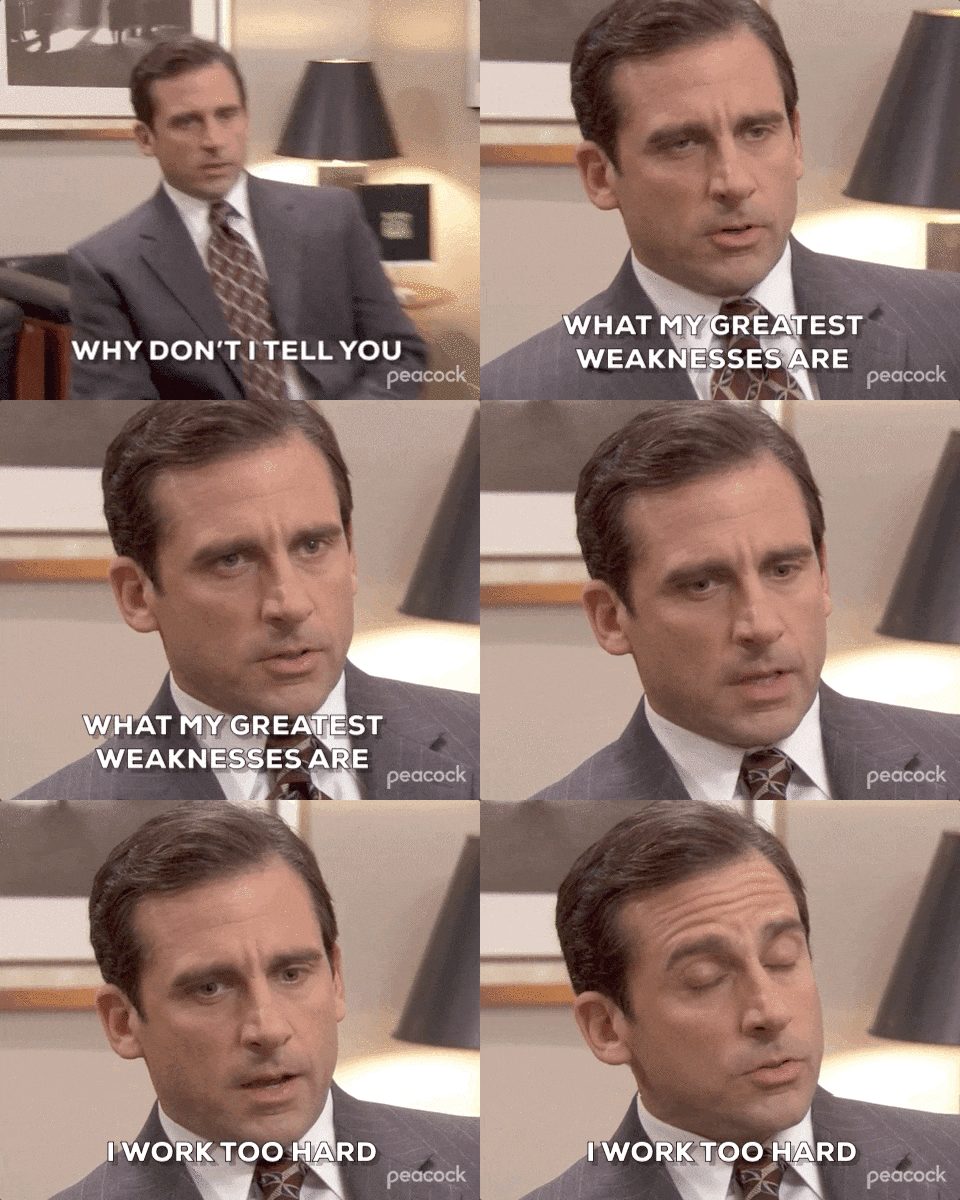
Dating apps haven’t just changed how we meet people. They’ve changed how we treat people. We’ve straight up just forgotten how to connect. Which is super unhelpful when we’re already feeling more disconnected than ever.
Dating apps have done what every other app created to monetise attention has done. They gamified something that shouldn’t be a competition. They gamified human connection. And they feed in to the social norm that puts being in a relationship on a pedestal.
They reward attention and volume. And after a decade of this experiment, the results are in.
People are lonelier, dating is more confusing and trust between men and women is eroding.
So here’s a genuinely radical idea.
What if we just…got rid of online dating entirely?
Seriously. What if we all just closed our accounts, deleted the apps and walked away from the low-return dopamine hit once and for all?
I fully acknowledge that this is not going to fix the hugely complex and systemic issues driving a huge wedge between genders right now. But dammit, I’m not prepared to suggest we just sit back and keep hating each other without at least letting that fire drive us toward some kind of action.
Now, I know this is already happening. Run clubs and in-person events are becoming more popular ways to meet new people. I love this for all of us.
But I’m now calling for a mass exodus. And this would just be the start.
Because if we are serious about fixing dating, the rules would need to change dramatically.
Not small tweaks. Not putting a pause on your Hinge account and reactivating 3 days later just in case your one perfect person finally caved and joined up. I’m talking about a complete cultural reset. Burn it to the ground.
It’s gonna be scary, guys, I won’t lie. We’ve de-skilled a little in the social interaction space. But stay with me, this could be the start of a revolution.
I think it goes something like this.
1. Stop making your relationship status the most interesting thing about you
Before we start redesigning how we meet people, there’s a first step that matters even more: we need to stop making our relationship status the most interesting thing about us.
For a very long time, women have been taught (subtly and not so subtly) that our lives revolve around partnership. Whether we had a boyfriend, a husband, or were “still looking” became the headline of our identity. The entire dating culture we’ve inherited relies on that assumption: that women need men, and that our lives are somehow incomplete without one.
But most of us know by now that this simply isn’t true.
You are already a whole person. Your friendships, your work, your passions, your children, your creativity, the quiet little rituals that make up your days? These things are the real architecture of a life. When those parts of your world are strong and meaningful, something interesting happens. Your sense of self-worth grows, your self-love deepens, and dating stops feeling like a desperate search for completion.
It becomes something else entirely.
You’re not looking for someone to rescue you from loneliness or give your life meaning. You’re simply open to meeting someone who might add something beautiful to an already full picture.
There is nothing wrong with wanting to call in an amazing love to your life. But de-centering romantic relationships creates a kind of non-attachment that is incredibly powerful. You’re no longer clinging to the outcome of every interaction or trying to force something to work. You’re just being yourself in the world.
And that’s exactly the energy that tends to attract the best people.
2. Go back to meeting people in the wild
If we were serious about resetting dating culture and stepping away from online dating, we will actually need to replace it with something. Like meeting new people out in the world.
For most of human history, people met each other in the course of their actual lives. Through friends, at work, at a party, at a class, at the gym, or standing in line for coffee. It wasn’t perfect, but it did have one important advantage: people encountered each other as humans first, not profiles in a catalogue.
The endless scroll of faces on dating apps has slowly turned people into something closer to products. When every interaction sits alongside hundreds of other possible options, it becomes very easy for connection to start feeling a lot like online shopping. Which is great for finding the perfect trench, not so much for finding your perfect match.
What it has also done is given us a social safety blanket. A screen to hide behind. And now we don’t even know how to introduce ourselves to a stranger, or what to do when we’re sitting at the bar with a smutty novel and a glass of pinot and someone asks what we’re reading.
So yes, we need to start approaching each other again. But surely we can get this happening without making it weird? We used to do it in the 90s. It was fine (I think?).
Obviously if someone is being a creep we owe them nothing, and safety always comes first. But can we find a middle ground here? The obvious one for me is to approach someone in the right context, ideally where there’s a shared interest or activity taking place. At a friend’s 40th and you spy their cute cousin? Go introduce yourself. Joined a new yoga studio and keep bumping in to the same hottie putting your shoes back on after class? Ask how their practice was. Or, be bold without being weird. My friend slipped a cute bartender her number written on a piece of paper recently. He texted her on his break. See how two adults just worked that out? We can do hard things, team.
3. Real life comes first
If dating moved back into real life, the pace of things would probably change as well.
Instead of weeks of messaging back and forth through an app, people would simply meet each other (or maybe be set up by friends) then make a date. Within a few days, ideally. Because grown-ups make plans. Please don’t make me tell you the difference between “We should grab coffee sometime” and “Are you free on Saturday morning? I’ll make a reservation”. Come on guys, we’re better than that.
The things that actually matter, like chemistry, humour, warmth, and kindness, are much easier to sense when you’re sitting across from someone. Someone’s text game can be strong but we need to bring back the in-person vibe check, stat.
I recently met someone in the wild and we had four in-person dates over 2 weeks. Aside from a few texts to confirm arrangements, all of our communication was face-to-face. Hours of actual conversation with our voices to get to know each other. Delightful.
4. Bring back the phone call
Before you recoil in horror please remember this: human connection is supposed to sound like humans connecting. It’s wild that talking to someone new on the actual phone seems radical, but sigh, here we are.
Hearing someone’s voice tells you far more about them than an endless thread of text messages ever will. A quick call to ask someone out, a call the day before a date, or a call afterwards to say you had a great time all create a sense of presence that texting rarely manages. Text first if you like, to let them know you’d like to call. Wait for a yes, then make the call.
If you want a new tech hack, go one step further and use FaceTime. This is a great way to vibe check someone before you commit to a couple of hours on a date. Find some good lighting, look them in their digital eyes and see what happens when you try to make them laugh. Go on, I dare you.
4. Pick a lane
By the time we reach mid-life, it’s probably reasonable to expect a bit more clarity about what people actually want.
Casual dating is completely valid. So is wanting a committed partnership. Literally just be clear about which one it is and communicate that to the person you are dating. The slippery middle ground (AKA “short term open to long”) is code for “I would prefer to keep all my options open indefinitely” and we all know it.
Imagine how much confusion could be avoided if people simply said what they want out loud? Clarity isn’t cruel. In most cases it’s far kinder than leaving someone trying to interpret mixed signals.
Being honest about your intentions doesn’t limit your chances. It carefully hones them, while respecting everyone’s time. If you are having trouble with this because you genuinely don’t know what you want, for love of God please stop dating. Take a breath, work it out, then go get it. Because I’ll tell you what most people don’t want – emotional confusion.
5. Effort
Underneath all of this is something very simple: effort.
I think modern dating has made us all a little lazy. We’ve got the potential love of our lives in our DMs and we think sending a thumbs up emoji constitutes meaningful engagement. No wonder we’re fumbling each other so hard.
To be clear, I’m not talking about ‘gram-worthy, not actually backed up by behaviour grand romantic gestures either (another shitty side-effect of us being chronically online). I just mean privately visible and consistent effort. Initiating plans, remembering the things someone tells you about their life, following through on what you say you’ll do.
You know, like actual listening and connecting and stuff.
These things shouldn’t be extraordinary. They should be the baseline.
If you think this is too much, or you just don’t have the energy for the effort required, that’s totally cool. But again, this is one of those situations where you need to stop dating. Get your own reserves up, do some emotional rehabilitation, take a nap. Do what you gotta to find the energy to date, then date. Not the other way around.
So what happens next?
At the risk of contradicting myself, I don’t think dating is actually dying. I think a very specific version of dating is dying.
The one built on vague intentions, low effort, and the assumption that women will tolerate confusion because partnership is something they need.
This is the context dating apps were launched into and have gone on to perpetuate for years.
But that version of dating is collapsing because the world that created it no longer exists.
Something new will take its place, because humans are still wired for connection. But if the next chapter of dating is going to work, it will have to look different: more honest, more intentional, with much higher standards and a focus on genuine connection because we want to, not because we need to. We might date less, but if we do, it had better be a value add. We might have to relearn a few social skills along the way, but I have a feeling it will be worth it.
Because when you’ve built a full, stable, meaningful life, the threshold for who gets to enter it becomes very clear.
If we really want dating to survive the next decade, we may need to stop trying to optimise the broken system we have.
And start building a better one.
Until next time, lovers.
Evie xx
This resonated for me.
I once met someone online whose text game was incredible. But when we first met in person the connection I expected to feel wasn’t really there. I gave it another chance and the connection grew — we even ended up engaged — but by the time I realized he didn’t actually have the capacity to meet me, I was already deeply invested.
It made me realize how easily messaging chemistry can mask deeper differences in relational capacity. The interesting part is that there are early signals of capacity — subtle ones — that show up much sooner than we think.
I’m super into this take, especially the part that refuses to pretend the current dating culture is merely “challenging” rather than structurally incoherent. A lot of what women are calling burnout is actually revelatory. After all, when partnership is no longer required for survival, the tolerance for confusion, low effort, and male entitlement drops fast.
Dating isn’t dead because the apps broke it. Dating is dying in its current form because women are no longer willing to audition for love. The old model depended on women needing partnership badly enough to tolerate ambiguity, misalignment, and obnoxious fuckery. That’s the real collapse. Of course, the apps certainly industrialized it.
And yes, meeting in real life, actual effort, and face-to-face conversation all sound like a saner alternative. Because we don't need dating to die... we need the death of desperation.