

Falling down as a grown-up sucks
+ can we please normalise sobbing in public?

Hello, my loves!
Have you ever taken a tumble as a grown-up? Like a full face-plant, a tangle of limbs, scraped hands and knees?
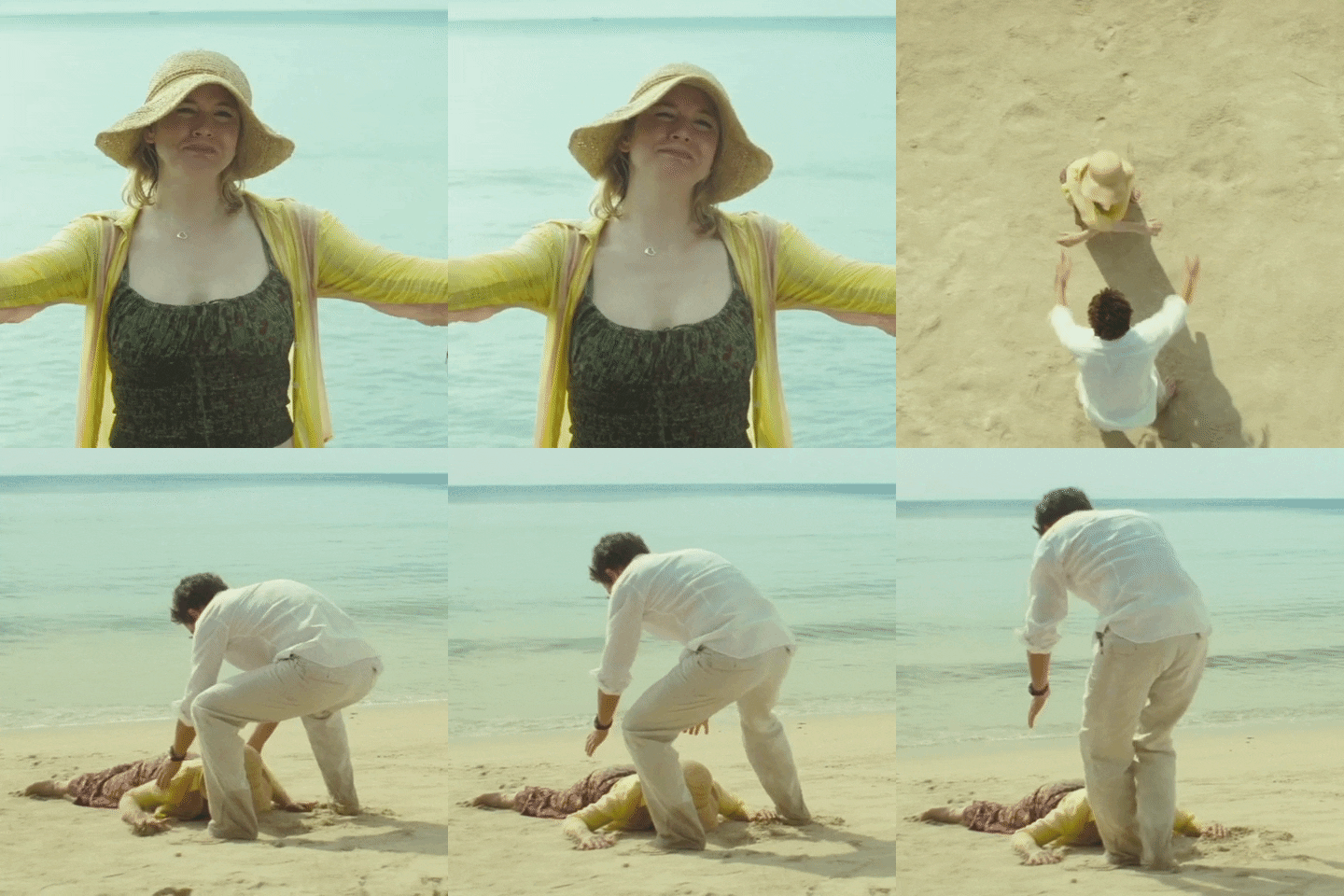
It’s so different to falling over as a kid. Maybe it hurt, we got a few cuts and bruises. But we bounced back up pretty quick. Dusted ourselves off. Got straight back on the bike. If it was really bad someone may have taken us to get medical treatment, because that’s what you do when a child hurts themselves badly, right?
But as a grown-up? We hit the ground harder. We’re less bouncy. It happens so infrequently that the shock is almost worse than the pain. We likely get up quickly and dust ourselves off, but we do this because it’s expected of us.
It would be weird and awkward if we burst into tears and asked for a hug.
Instead, we excuse ourselves to a quiet corner to sniffle and sob in private, all the while assuring everyone around us that we’re fine. We refuse medical treatment because we should just be able to get over it.
And this — this is exactly how we treat heartbreak in mid-life.
We go down hard.
We rupture something important.
And then we act like it’s a sprain.
When you’re 22 and someone breaks your heart, it hurts. God, it hurts. But your life is still largely ahead of you. The future feels elastic. There are infinite possibilities and versions of yourself still waiting in the wings. You cry on your friend’s couch. You drink cheap wine. You write dramatic texts you don’t send. The pain is real, but it exists inside a life that still feels wide open.
As I engage in more and more conversations about heartbreak in mid-life, the thing that strikes me hard is the low-level shame many of us feel for admitting we’re been really knocked around love. Or, at least, there’s a reluctance to do what our 4 year old self might have done when they hurt themselves — scream and cry and ask for a cuddle.
Let’s get into it, shall we?
Mid-life heartbreak is different.
By the time you’re in your 40s (and especially if you’ve built a long-term relationship, a home, children, shared friendships, shared finances etc.), a breakup is not just the loss of a person.
It’s the amputation of a future.
Look, I get that sounds dramatic. But let’s be real. The older we get the less energy we have for reimagining our lives over and over again. There’s genuine excitement and opportunity to be claimed after a break-up, for sure. But when you haven’t even had a chance to get back after the tumble, the idea of having to erase what you allowed yourself to hope your future might look like and start again? Pretty damn exhausting.
It’s the collapse of a structure you spent precious time building. It’s the disintegration of an identity you wore for a long time: wife, girlfriend, partner, someone’s chosen person. It’s the quiet horror of realising you are starting again at an age when you thought you’d already done the starting.
That’s huge.
And yet.
We treat it like a bad mood.
We expect ourselves to keep working.
Keep parenting.
Keep showing up to Pilates.
Keep replying to emails.
Keep smiling and laughing at the family barbecue because dammit why can’t I JUST BE HAPPY.
We might give ourselves a week. Maybe two. And then the world subtly (or not so subtly) signals that it’s time to move on. I mean, the image of a 46 year old woman crying into a bowl of ice cream and obsessively checking social media doesn’t naturally evoke the empathy it should. Like most things relating to middle-aged women, the reaction from the outside world is to judge, shame and write it off as either pathetic or hysterical (or both, why not?).
But if you tore your ACL, no one would expect you back on the field the following Saturday. If you broke your arm, no one would ask you why you’re “still talking about it.” If you had surgery, no one would suggest that you just think more positively.
Here’s the thing about that, though.
Heartbreak is not a bruise. It is a trauma event.
Your nervous system doesn’t care that the injury is emotional. It responds as if you are under threat. Sleep goes. Appetite changes. Focus disappears. Your brain loops. Your body feels heavy. Or wired. Or both. You feel like a stranger inside your own skin.
And here’s the part we don’t talk about enough: in mid-life, heartbreak often reactivates every other loss you’ve ever experienced.
The loss you never properly grieved.
The friendship that quietly dissolved.
The version of yourself you abandoned to keep the peace.
The years you invested in something that did not hold.
It is layered grief. Compounded and cumulative. Like an old sporting injury that never fully healed.
If you walked into an emergency department with compound fractures, they wouldn’t send you home with paracetamol and a pep talk.
They would immobilise you and assess the damage. You’d get a treatment plan with the expectation that rehabilitation takes time.
So why do we deny ourselves the same when we have a broken heart?
Why do we insist on functioning at full capacity when our emotional bones are splintered?
I know for me, it’s part pride, part fear and part being the one who always holds her shit together for everyone else. No matter what.
We are the grown-ups now. No one rushes in automatically with a hug and a bandage. So we rationalise and minimise the pain. We push through because that’s what grown-ups do.
We tell ourselves:
“It wasn’t that bad.”
“I should have seen it coming.”
“I’m too old to be this upset.”
“At least I have my children.”
But minimising an injury doesn’t heal it. It just delays the repair.
Try something with me.
If you are in mid-life and your heart has been broken, I want you to consider something radical:
What if you treated this like a serious physical injury?
What if you assumed, from the outset, that you are not supposed to be okay right now?
What if you built a recovery plan instead of a performance plan? One that was modelled on what you might expect for a physical injury. With rest, immobilisation, pain management and support.
Emotional rest might look like cancelling non-essential commitments. Deleting social media for a bit. Lowering your standards at work for a season. Telling your closest friends the truth instead of saying “I’m so fine, better off without him anyway.”
Immobilisation might mean no contact. Not because you’re dramatic. But because re-opening the wound every few days is not conducive to healing. I have gone no contact for my last 2 break ups and it is hard, but so worth it. Side note: If I went no contact during one of the break-ups my ex-husband and I had when we were dating, I would never have married him.
Pain management might mean therapy. Journaling. Walking. Sleep. Actual medication if needed and appropriate. (And no, there is no gold star for white-knuckling your way through.)
Support might mean letting someone cook you dinner. Pick up your kids. Sit beside you while you cry, rage or simply for company while you watch Real Housewives.
And then there is rehabilitation.
Rehabilitation is slow. It is repetitive. It is boring. It is two steps forward, one step back. It is building strength in tiny increments. It is noticing that the pain is not as sharp this week as it was last week. It is realising you went an entire afternoon without thinking about them.
It is rebuilding your life, not in a dramatic phoenix-from-the-ashes way, but in small, sturdy ways.
So if you are on the ground right now — I’m talking wind knocked out of you, skin scraped, pride bruised — I want you to stop pretending you’re fine.
You are not fine. You are injured. And injured people deserve treatment, time and tenderness.
I can’t promise you that the world will be as kind to you as it should be. Or that your children will suddenly stop needing things, or your workplace will ease up on the deadlines.
But I can promise that if you give yourself time, tenderness and permission to
stop performing strength while you quietly bleed, you will come out of recovery with a heart that has seen some shit, but ready for the next great adventure.
Whatever that may be.
Until next time, lovers.
Evie xx
I resonate with so much of what you said. A break up in midlife almost feels like a teenage heartbreak (at least for me). There’s this annihilation that happens and it can feel so debilitating.
What you said about the amputation of a future hit different levels of my heart that I really needed in this moment.
Thank you.
I absolutely love this approach and it’s so true. The part you wrote about heartbreak midlife opening up every other hurt we’ve ever had … I felt that. Thank you for sharing. I’ve subscribed because I definitely need more of this in my life. Thank you for your writing!